SDS SMALL SCALE SPRAY DRYERS
Spray Drying Systems, Inc. offers standard small scale
spray drying plants which can be used for research and development, pilot scale
testing, or small scale production of spray dried powders.
Each has a fixed diameter drying chamber and a fixed airflow,
and are custom configured with various choices of features and
options.
The Model 48
has a maximum water evaporation rate of 155 lb/hr. It is
the smallest spray dryer available anywhere that can be used
with pressure nozzle atomization.
The Model 60
has a maximum water evaporation rate of 250 lb/hr, and has all
the same features and configurations of the Model 48.
The Model 72
has a maximum water evaporation rate of 345 lb/hr, and has
many of the same features and configurations of the Model 48
and Model 60.
Because the airflows are fixed, the actual evaporation rate of each Model depends upon the air
temperatures used for drying.
The maximum particle size capability of each Model depends
upon the nozzle configuration used, the height of the drying chamber, and the type of product being
dried.
All Models are "customized" in configuration and
standard features in each quotation to best suit the requirements of our
customers. These variations include
materials of construction, type of atomization, height of the drying chamber,
the powder collection types and locations, and internal
finishes.
A direct fired
natural gas air heater provides the energy required for
evaporation, with a maximum inlet air temperature of 1,2000F.
Atomization for our small scale spray dryers is
provided by either a pressure nozzle, or a two-fluid nozzle.
Nozzle configuration can be co-current (spray down) or
mixed-flow (spray up).
Powder collection choices include chamber separation, cyclone, and bag filter.
The ducting and cyclone use tri-clamp connections for ease of
disassembly.
The standard NEMA 12 control panel includes inlet and outlet
air temperature indication, PID temperature control, feed pump
speed control, system pressure indication, temperature and
pressure safety switches, the flame safety relay, a local
disconnect, as well as all the required start/stop buttons,
on/off switches, and indication lights.
All components of SDS spray dryers are engineered and
manufactured right here in the United States.
SDS can provide custom designed small scale spray drying systems
for needs that go beyond the standard Model 48, Model 60, and Model 72
variations, such as closed loop systems which are typically
used when organic solvents are being evaporated.
|
|
|
|
|
|
|
|
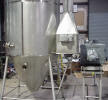
A custom designed closed loop spray dryer for organic solvent evaporation using nitrogen as the process gas.
|
|
|
|
|
|
|
|
Contact SDS for more information on our Small
Scale Spray
Dryers, and what we can do to help meet your spray dryer needs.
LABORATORY SPRAY DRYERS
Small laboratory spray dryers, typically 30 inches in
diameter or less, are useful for many situations and
testing requirements, including feed formulation studies,
producing samples for testing, and determining optimum drying
conditions. But in many cases and for many products,
these spray dryers
are not useful for producing the desired particle size, or for predicting the other physical properties that can be achieved in production scale spray dryers. This is especially true for
small R&D spray dryers using rotary atomization, as the
particle size results obtained on the small atomizer cannot be
duplicated in many instances by larger atomizers at the feed
rates of large scale spray dryers. The average particle size
ability of small R&D spray dryers is typically limited to 30
micron maximum, as the chamber size is not large enough to
allow larger droplets to dry before contacting the walls and
sticking. A pressure nozzle can not be utilized on these
smallest spray dryers, which eliminates the evaluation of this
important type of atomization. The ability to test high
air temperatures, which can significantly decrease the size
and cost of a new production system, is limited. The residence
time is limited, which can lead to the need for higher outlet
air temperatures on the small dryer to achieve the desired
powder moisture level.
|